- Templates |
- Research Project Plan
Research project Gantt chart template
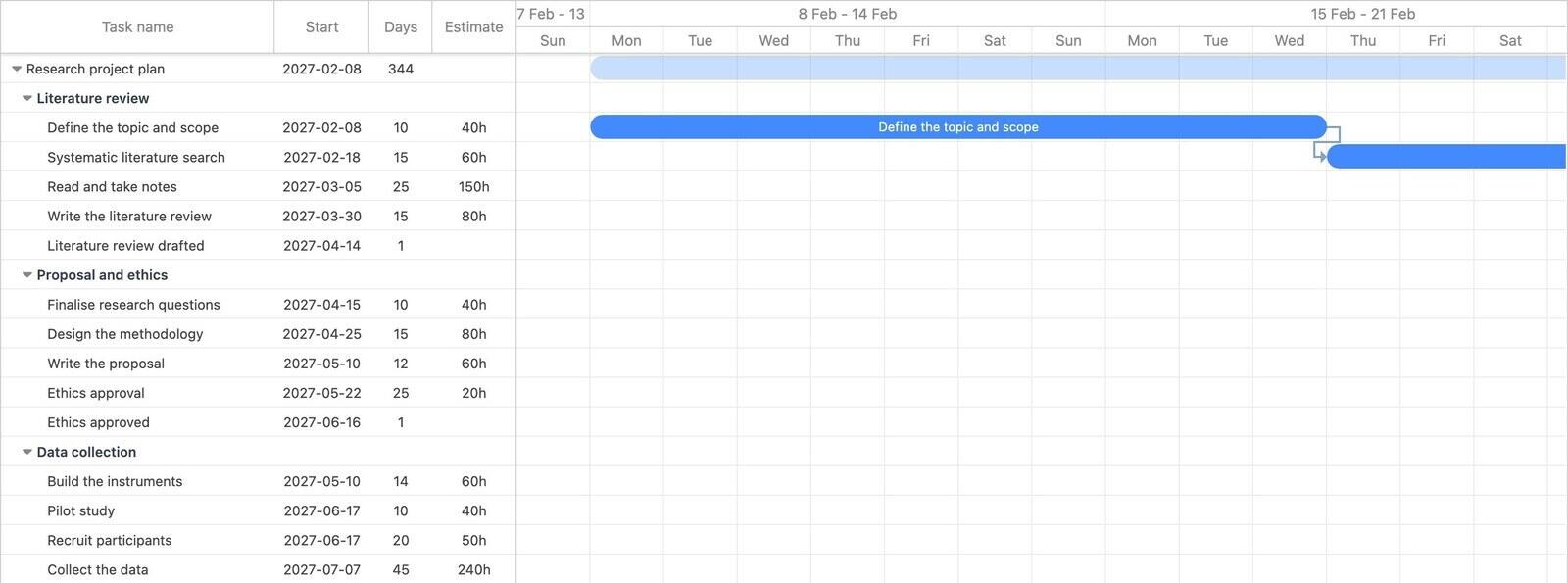
Plan the work from literature review to submission, with time for ethics approval, writing and supervisor feedback. Adapt the six phases to your research proposal, dissertation or PhD.
- 6 phases
- 23 tasks
- 6 milestones
- 31 dependencies
- About 11 months
What is in this template?
| Phase | What it covers |
|---|---|
| Literature review | Scoping the topic, a systematic search, reading, and writing the review. |
| Proposal and ethics | Research questions, methodology, the proposal itself, then the ethics approval wait. |
| Data collection | Instruments built during the ethics wait, then pilot, recruitment and the main collection period. |
| Analysis | Cleaning and coding, the analysis itself, and interpreting the findings. |
| Writing | Methods drafted while the analysis runs, then results, discussion and the full draft. |
| Submission | Supervisor review, revisions, proofreading and submission. |
The two waits that break research timelines
Most research plans fail in the same two places, and both are visible on this chart as long bars you cannot compress by working harder.
Ethics approval runs for five weeks and nothing in the field can start until it clears. The template does two things about that: it submits as early as the methodology allows, and it builds the data collection instruments during the wait rather than after it. That single overlap saves about three weeks.
Supervisor review is another queue. Two to three weeks is normal, not pessimistic, and it lands right at the end when there is least room. Planning it honestly is better than discovering it in month ten.
Write while you analyse
Draft the methods chapter as the work develops, then revise it to reflect what you actually did. Writing alongside the research can expose questions early and reduce the amount left for the final months.
Adapting the timeline for a dissertation
The template runs for about eleven months. That may suit some master's research projects, but dissertation periods vary by course and institution. Start with your submission date and required reviews, then work back through the research you need to complete.
- Add the proposal deadline. Confirm which approvals your department requires before an ethics application or data collection. Link only the work that must wait for those approvals.
- Estimate collection and analysis together. Recruitment, access to data and the analysis method all affect the time needed. If the scope will not fit, discuss it with your supervisor rather than assuming writing can absorb the delay.
- Protect time for the final checks. Include references, formatting, accessibility checks and submission requirements. Choose a buffer that fits the size of the document and your institution's process.
A literature review already completed for another module can give you a starting point, but leave time to update it as the question and findings develop.
Adapting the timeline for a PhD
A PhD plan may need repeated studies, new research questions and formal progress reviews. Adjust the template's structure as well as its durations. Requirements differ between disciplines, institutions and full-time or part-time programmes.
For illustration, a three- to four-year project could include these stages:
- Early research: refine the question, review literature, develop methods and seek any required approvals. Add an upgrade or confirmation review if your programme requires one.
- Main research: show each study or collection-and-analysis round separately. Link rounds only where one needs the previous results, and allow for methods to change as the research develops.
- Writing and revision: draft throughout the project, with a substantial period for bringing the chapters together and responding to feedback. Update the literature review before submission.
- Examination and completion: include viva or defence preparation, the examination and corrections where applicable. Use your institution's deadlines and leave room for examiner availability.
Add required progress reviews to the chart. Check which ones are formal gates and which simply record progress; do not make all later research wait on a review unless the programme requires it.
Where supervisor reviews belong
Agree review points and turnaround times with your supervisor. The template includes a review near the end, but your project may need feedback on the proposal, methods, individual chapters and full draft.
- Proposal review: allow time to refine the question and method before submitting any required application.
- Methods review: seek feedback early enough to address gaps before the relevant research begins. Later revisions should describe the work accurately.
- Full draft review: show both the feedback period and the time you need to respond.
- Final checks: agree whether the revised document needs another review before submission.
Use a task bar for the review period and a milestone for the decision or feedback received. This makes the waiting time visible without assuming feedback arrives on the day you send the draft.
Planning around ethics approval
The template allows five weeks for ethics review. Treat that as a planning example, not an expected turnaround. Check your institution's process, submission deadlines and meeting dates, and allow time for requested changes.
Link recruitment, a pilot or data collection to approval where the rules require it. If revisions and resubmission may be needed, place that work before the approval milestone. Preparatory work that does not require approval can continue in parallel.
A delayed approval may put pressure on the submission date. Review the scope and remaining work with your supervisor rather than assuming the deadline can move automatically.
How do you adapt it?
Click Use template and the whole timeline is copied into your account starting on the coming Monday. Then stretch each phase to your own project using the dissertation or PhD durations above, add the milestones your programme requires, and change the ethics bar first if your process is faster or slower than five weeks, because everything downstream is linked to it.
When it looks right, export the chart as an image or a PDF and put it in the proposal, the dissertation plan or the annual review pack.
Common questions
Can I use this Gantt chart in a research proposal?
Yes, that is what it is built for. Many funders and supervisors ask for a timeline as an appendix. Adjust the durations to your project, then export the chart as an image or PDF and drop it in.
Does it work as a dissertation Gantt chart?
Yes. Adapt the eleven-month example to your course dates, research method and review requirements. Dissertation lengths vary, so confirm the schedule with your supervisor.
How do I turn it into a PhD Gantt chart?
Adjust both the durations and the structure. Add repeated research rounds, required progress reviews, and examination or corrections where relevant to your programme.
Why is ethics approval such a long bar?
Approval can take time and may require revisions. Showing it separately makes clear which work must wait. Replace the five-week example with an estimate based on your institution's process.
Do I need to include the writing phase?
Yes. Writing takes roughly a third of this example, with additional time for supervisor review and revisions. Adjust those periods to the document and feedback process you need.
 Breeze
 Timen
Timen


