- Templates |
- Weekly Project Plan
Weekly Gantt chart template
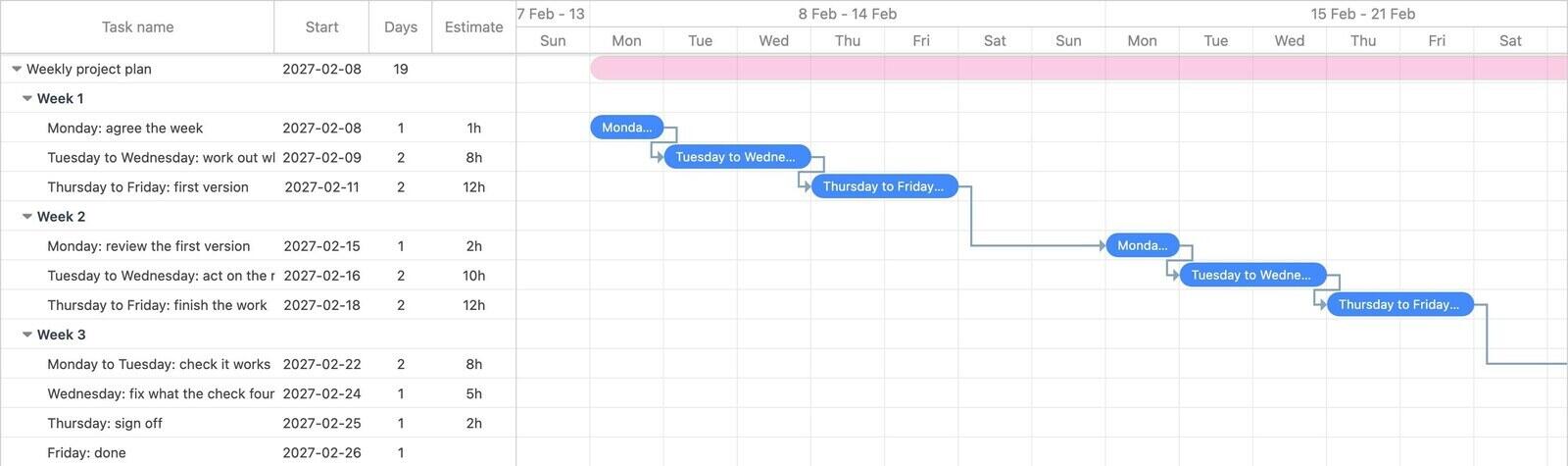
Most Gantt charts are built for months. This one is built for days: three weeks, one phase per week, and tasks that run one to three days each, laid out Monday to Friday. For work that is real but small, where the order matters but a five-month programme chart would be absurd.
- 3 phases
- 9 tasks
- 1 milestone
- 9 dependencies
- 3 weeks
What is in this template?
| Week | What happens |
|---|---|
| Week 1 | Monday to agree the week, Tuesday and Wednesday to work out what is needed, Thursday and Friday for a first version. |
| Week 2 | Monday to review, Tuesday and Wednesday to act on it, Thursday and Friday to finish the work. |
| Week 3 | Monday and Tuesday to check it works, Wednesday to fix what the check found, Thursday to sign off, Friday: done. |
When is a weekly chart worth making?
For a single week it usually is not — a list does the job. It starts earning its place at around two to four weeks, at the point where two things become true: the order of the work matters, and somebody other than you needs to know when their part comes up.
The three-week span is also about as far as day-level detail stays honest. Past that, estimating in days stops being planning and starts being fiction, and you are better off with the project schedule template.
Weekdays are the point here
Every task in this template starts on a weekday, and when you copy it the whole plan is shifted so it begins on the coming Monday. That matters more at this scale than at any other: a three-week plan whose tasks land on Saturdays is not a plan.
Turning on Hide weekends under Settings compresses the chart to working days only, which makes the three weeks read as fifteen columns instead of twenty-one.
How do you adapt it?
Click Use template and the plan lands in your account starting on the coming Monday. The day names in the task titles are there to show the rhythm — rename them to your actual work as you go. If a task genuinely takes four days, stretch it and watch what happens to Friday.
Common questions
Is a Gantt chart useful for one week of work?
Usually not — a list is enough. It starts earning its place at two to four weeks.
Why does every task start on a weekday?
Because at this scale weekday alignment is the whole point. Copies start on the coming Monday, so the rhythm survives.
Can I hide weekends?
Yes. Turn on Hide weekends under Settings in the chart toolbar.
How do I repeat it each week?
Copy the template again for a new block of work. For continuous work, extend the phases instead.
 Breeze
 Timen
Timen


