- Templates |
- Software Development Plan
Software development plan template
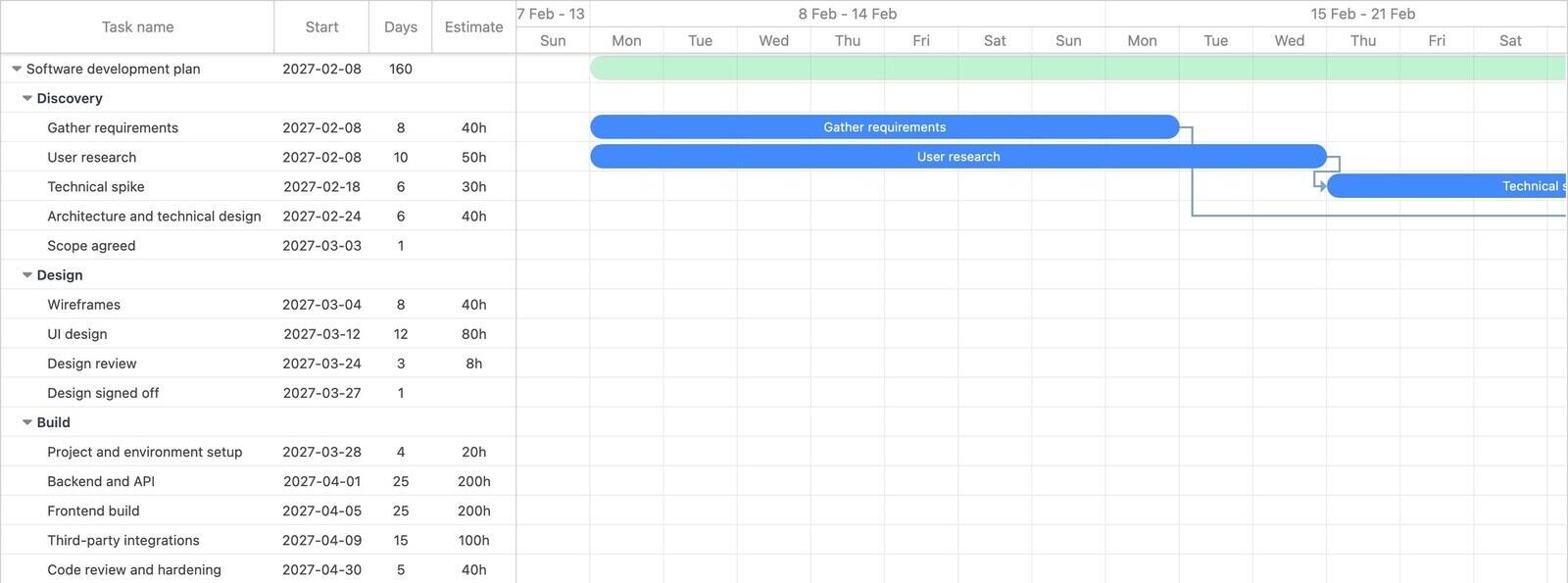
A software project laid out end to end, from the first requirements conversation to the week after release. Six phases, twenty-three tasks and thirty-one dependencies, with the build drawn the way it actually runs: backend, frontend and integrations overlapping rather than queuing.
- 6 phases
- 23 tasks
- 6 milestones
- 31 dependencies
- About 5 months
What is in this template?
| Phase | What it covers |
|---|---|
| Discovery | Requirements, user research, a technical spike for the one unknown that would change the architecture, then the architecture itself. Ends on Scope agreed. |
| Design | Wireframes, UI design and a review, ending on Design signed off. |
| Build | Environment setup, then backend, frontend and integrations overlapping, then hardening. Ends on Feature complete. |
| QA | The test plan written during the build, then a full pass, bug fixing and regression, ending on Release candidate. |
| Beta | Prepare, run, and act on feedback, ending on Beta signed off. |
| Launch | Release prep and documentation in parallel, ship, then a monitoring window. |
The technical spike earns its row
Discovery includes a six-day spike between the research and the architecture. It exists to answer the single question that would change the whole design if you got it wrong — the third-party API that may not do what the docs claim, the performance assumption nobody has tested.
Six days early is cheap. The same discovery in month four is a rewrite. Putting it on the chart as a real bar with a real duration is the point.
Where the schedule is won and lost
Two pieces of sequencing in this template are worth keeping when you adapt it:
- Backend and frontend overlap. Once an API contract exists, they do not need to be sequential. Drawing them one after the other is the most common way a plan doubles in length before anyone has written a line of code.
- The test plan is written during the build. QA then starts the day the build lands rather than spending its first week writing the plan.
Does this work with agile?
Partly, and it is worth being clear about which part. Sprint-level work does not belong on a Gantt chart — a board handles that better. What belongs here is everything with a fixed date around the work: the beta window, the launch, the dependency on another team, the security review that takes three weeks regardless of how fast you code.
Most teams end up with both. Gantt chart vs kanban board covers where the line falls.
How do you adapt it?
Click Use template and the plan is copied into your account, shifted to start on the coming Monday. Then set real durations, split the build bars into your actual components, and delete the beta phase if you ship straight to production. If you are also choosing tools, Gantt chart software for software development compares the options.
Common questions
Does a Gantt chart work for agile teams?
For sprint-level work, no. For the phases around the work — a beta window, a launch date, another team's dependency — it is useful. Most teams use both.
Why do backend and frontend overlap?
Because they can, once an API contract is agreed. Running them one after the other is the most common way a software plan doubles in length on paper.
Why is the test plan written during the build?
So QA can start the day the build lands instead of spending its first week writing the plan.
Is the post-launch monitoring bar necessary?
Yes. The week after a release is never free, and leaving it off the chart is how the next project starts late.
 Breeze
 Timen
Timen


