- Templates |
- Product Launch Plan
Product launch plan template
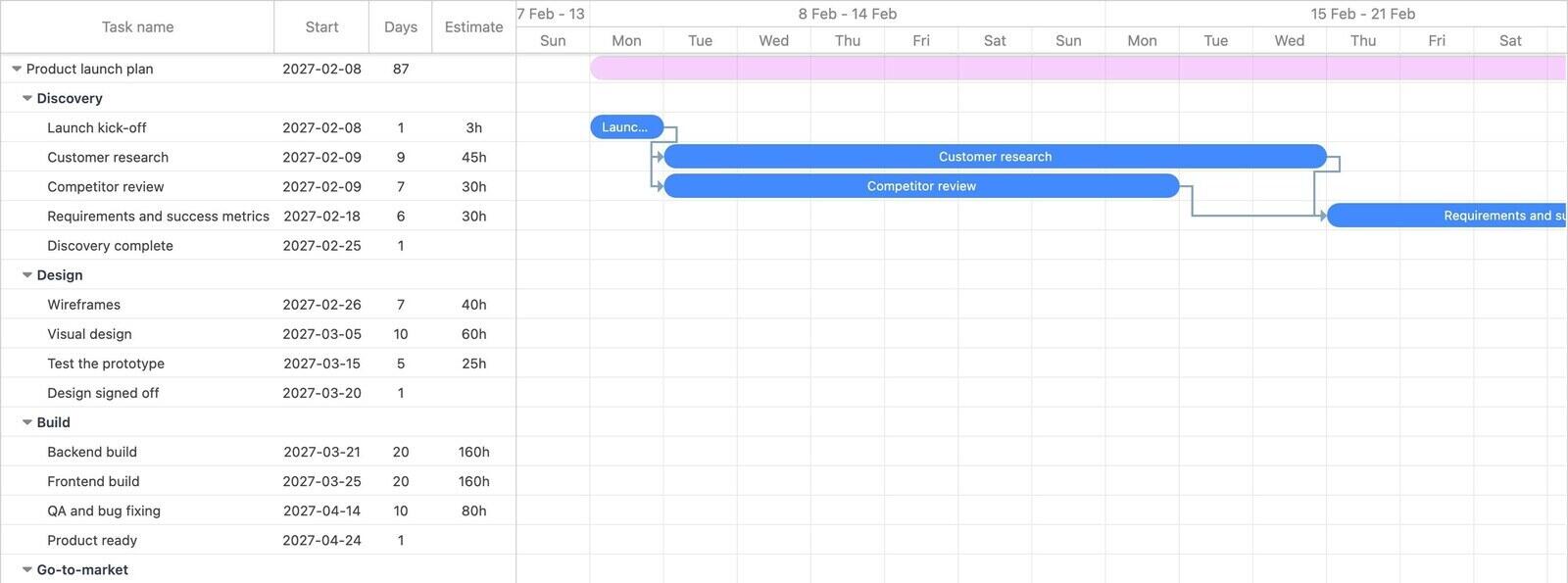
A twelve-week product launch with one structural decision built in: the go-to-market track starts the same day as the build, not after it. Four phases, sixteen tasks, and a single launch milestone that both tracks have to feed into before it can be reached.
- 4 phases
- 16 tasks
- 4 milestones
- 23 dependencies
- About 12 weeks
What is in this template?
| Phase | What it covers |
|---|---|
| Discovery | Kick-off, then customer research and a competitor review in parallel, then requirements and success metrics. |
| Design | Wireframes, visual design and a prototype test, ending on Design signed off — the point both later tracks start from. |
| Build | Backend and frontend overlapping, then QA. Ends on Product ready. |
| Go-to-market | Positioning, pricing, launch assets, then press and sales enablement — all running alongside the build. |
The one thing this template is arguing for
Look at the preview and you will see two tracks running side by side from the design sign-off: the build on top, go-to-market underneath. That parallelism is the whole point.
The common failure is sequential: build the thing, then work out how to sell it. That adds four to six weeks to the launch date for no reason, because positioning, pricing and launch assets do not need finished code — they need a signed-off design and a clear idea of what the product does.
Drawing both tracks on one chart also makes the real risk visible. It is rarely the code that is late. It is the pricing decision nobody has made, or the sales team who first hear about the launch the week before it happens.
One milestone, three predecessors
Public launch depends on three things at once: the product being ready, press and outreach being done, and sales and support being enabled. If any one of them is not finished, the milestone moves.
That is a more honest model than a launch date that only tracks engineering, and it forces the conversation early rather than in the final week.
How do you adapt it?
Click Use template and the plan is copied into your account starting on the coming Monday. Set your real launch date, then decide which track has to compress to reach it. If you are launching a feature rather than a product, keep the four phases and cut the durations to about a third.
Common questions
When should go-to-market work start?
The day the design is signed off, at the same time as the build. Waiting for the product to be done is the most common reason a launch slips by weeks.
How long is this launch plan?
Twelve weeks to launch plus two weeks of monitoring. Discovery and design take the first six, which is more than most plans allow and roughly what they need.
What feeds into the launch milestone?
Product ready, press done, and sales and support enabled. If any one is missing the milestone moves.
Can I use it for a feature launch?
Yes. The shape holds; compress the durations to about a third.
 Breeze
 Timen
Timen


